
AI that lightens the load for the public sector, within safe boundaries
Staff shortages, high workloads and information scattered everywhere and nowhere. We deploy AI in a way that wins your team time back, with privacy, GDPR and explainability as the starting point and not an afterthought.
Trusted by






Who it is for
For municipalities, public organisations and spatial-planning consultancies that have more work than hands.
Demand on government keeps growing, while staffing is tight and experienced people are retiring. Meanwhile, a lot of time disappears into rewriting texts, answering the same questions and searching for information that lives somewhere in the organisation but cannot be found.
Recognise two or more?
Then this work is a good candidate for AI. The AI audit establishes whether it really is.
How we work with the public sector. In three steps.
We start with your processes, not with a tool. First we pinpoint where the gains are, then we build in short iterations, then we make sure your team actually uses it.
- 1 Explore and pinpoint opportunities
- 2 Build and iterate
- 3 Roll out and guide
Cases · Government & public sector
What we already built in government & public sector.
No demos or slides, but working AI in production at companies in your sector. See what is live and what it delivers.
View all cases

What you get out of it
What AI delivers in the public sector.
Concrete time savings on day-to-day work, without giving up care or control.
-
Policy and documents
Drafts and summaries in minutes
AI helps draft text for policy documents, council proposals, zoning plans and formal responses, and condenses long files and reports down to the essentials. You stay in control: a person reviews, adds and signs off. With custom AI software we connect this to your own templates and house style.
-
Citizen questions and service
Faster answers, the same resident helped
An AI agent catches frequently asked questions, routes them to the right place and prepares answers based on your own, verified information. That frees up staff time for the complex cases where human judgement is genuinely needed. Transparent by default: the resident knows AI is involved.
-
Knowledge and information
One searchable source of truth
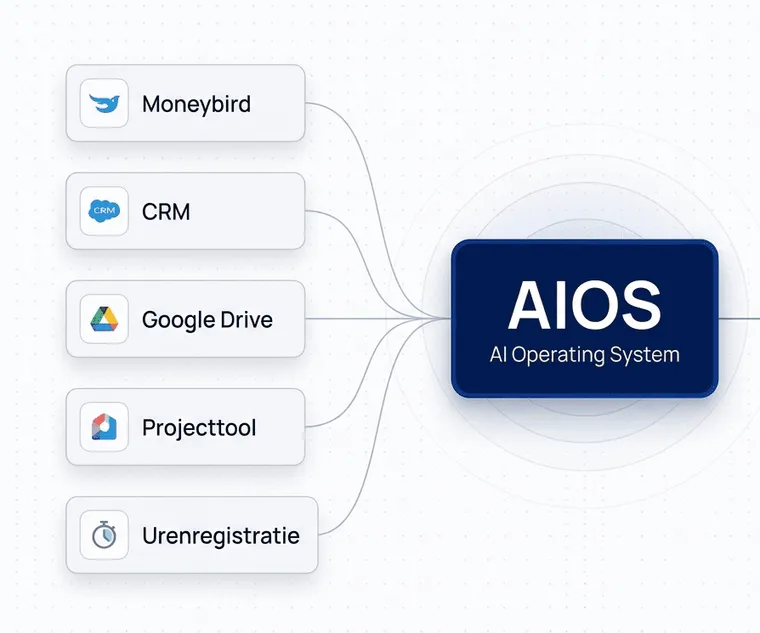
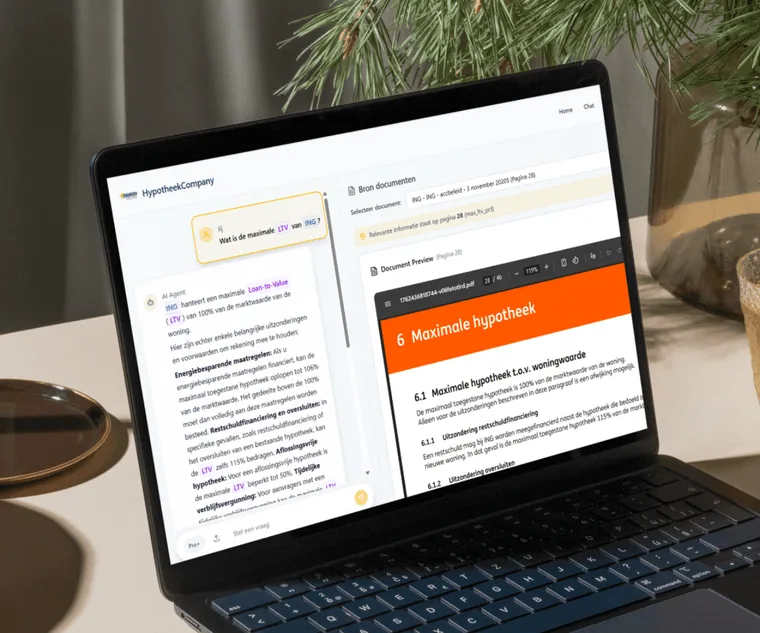
AIOS brings your scattered documents, policy papers and knowledge together into one searchable environment that answers with sources cited. That way knowledge is retained when experienced colleagues leave, and new staff find in seconds what used to take hours, with clear provenance for every answer.
What it costs
A single session or a broader programme.
From an interactive session to get the team on board to a broader programme with concrete applications: we agree on scope and a fixed price up front.
Are civil servants allowed to use ChatGPT or other AI for their work?
That depends on your organisation's policy and the tool. Free, public AI services are unsuitable for most governments, because there is no data-processing agreement in place and data can end up outside the organisation. With a business or locally hosted solution, a data-processing agreement and clear working arrangements, it can be done responsibly. We help you set those boundaries and choose the right tooling.
Is AI secure enough for privacy-sensitive government information?
It can be secure, provided you set it up properly. The starting point is data minimisation: personal and special-category data do not belong unfiltered in a prompt. We work with solutions where data stays within your environment, put data-processing agreements in place and help with a DPIA where needed, so you stay compliant with the GDPR.
Does government use of AI comply with the European AI Act?
The AI Act sorts AI systems into risk categories, and governments more often deal with high-risk applications. That calls for documentation of where and how AI is used, risk assessments and human oversight. We take these requirements into account for every application and help you make the deployment demonstrable and explainable.
So does AI make decisions about residents?
No. In our work AI supports staff, but the person decides. Citizens have a right to human intervention and an explanation for decisions, so we use AI for the preparatory work, such as summarising, drafting and retrieving information, and not for automated decision-making. Where AI has contributed, we make that transparent.
How do I know where an AI answer comes from?
Explainability is a hard requirement, not an extra. Our knowledge solutions answer with sources cited, so a staff member can click through to the underlying document or policy paper. That way you can verify the answer yourself and build trust, instead of blindly following a black box.
Where is the best place to start with AI as a municipality or public organisation?
Start small and provable. With an AI audit we map out, in fourteen days, where AI delivers most in your processes, with an estimate of the value and the preconditions per opportunity. After that you tackle one or two applications in a focused way, such as summarising case files or a searchable knowledge base, instead of starting everywhere at once.
Our other services
- AI audit In 14 days, a prioritised opportunity report with ROI per opportunity.
- AI consultancy A strategic sounding board that sets the right AI direction.
- AI agents Digital workers that take tasks off your plate, live within 2–4 weeks.
- AI customer service Customer questions handled 24/7 on web, WhatsApp and email, with a human in the right place.
- AI automation Repetitive work gone: documents, invoices, customer contact and integrations, automated with AI.
- Custom AI software Web apps, automations and integrations. Fixed scope, fixed price.
- AI Operating System One system that brings all your business data together and makes it searchable.
- AI workshop In a single day, from theory to hands-on AI skills for your team.
- System integration API integrations and one integration layer, so data flows by itself.
- AI knowledge management An internal knowledge base on your own documents, with source and version.
- Finance automation Invoices, controls and month-end close, with the controller in charge.
You can feel it has to change,
we
show you how.
You know where the friction is. We help you figure out how AI can genuinely fix it.
Not ready for a conversation yet? Get honest AI advice first →
30 minutes. Online or in Enschede. You decide.