
AI knowledge management: every answer with its source.
We build an internal knowledge base on your own documents, policies and systems. Staff search across documents with an ordinary question and get the answer with the source and the version alongside it. That turns knowledge management into something people actually use, and keeps knowledge in the business when people leave.
Trusted by



Sound familiar?
The knowledge is there. It just cannot be found.
Policies in SharePoint, procedures in a shared drive, the real answers in someone's inbox or a colleague's head. Even with good document management, searching your documents returns a list of files, not an answer. Two colleagues give two different answers, and when someone leaves, their knowledge leaves with them.
Recognise two or more?
Then this work is a good candidate for AI. The AI audit establishes whether it really is.
How it works
Your documents stay where they are, the answers come together.
An AI knowledge base works on the documents you already have. Staff ask an ordinary question and get an answer instead of a list of files.
- Word and PDF
- Google Drive
- SharePoint and intranet
Knowledge layer
Searches your own sources by meaning
4 of 4 sources connected, delivers 3 outcomes.- Answer with source A reference to the document
- Version with every answer Old versions no longer used
- Access by permissions Follows the permissions you already have
From scattered documents to one knowledge base.
First the sources and the questions, then the knowledge base, then into daily work. Fixed scope, fixed price. And we stick around.
- 1 Map sources and questions
- 2 Build and test the knowledge base
- 3 Live in daily work and kept up to date
What we build
Knowledge you can find again, with sources.
From an internal search tool to knowledge that is captured automatically. Always on your own sources and on top of your existing document management, with a reference to the document the answer comes from.
-
Internal AI search tool
Search your documents in plain language.
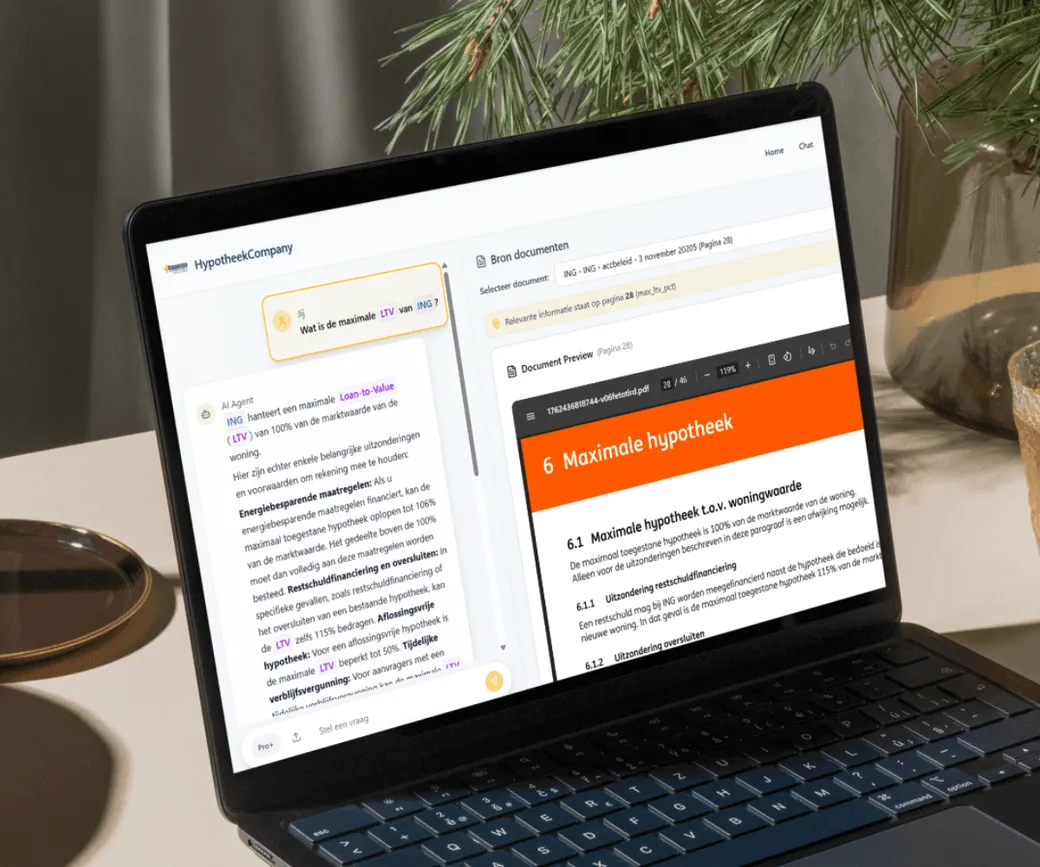
A search tool that searches your policies, handbooks and procedures and answers with source and version. For HypotheekCompany we built one on the underwriting guides of all their lenders: the Support Center has a verifiable answer in 2 to 3 seconds, saving 5 to 8 minutes per question.
-
Reading and comparing documents
From the document into the overview.
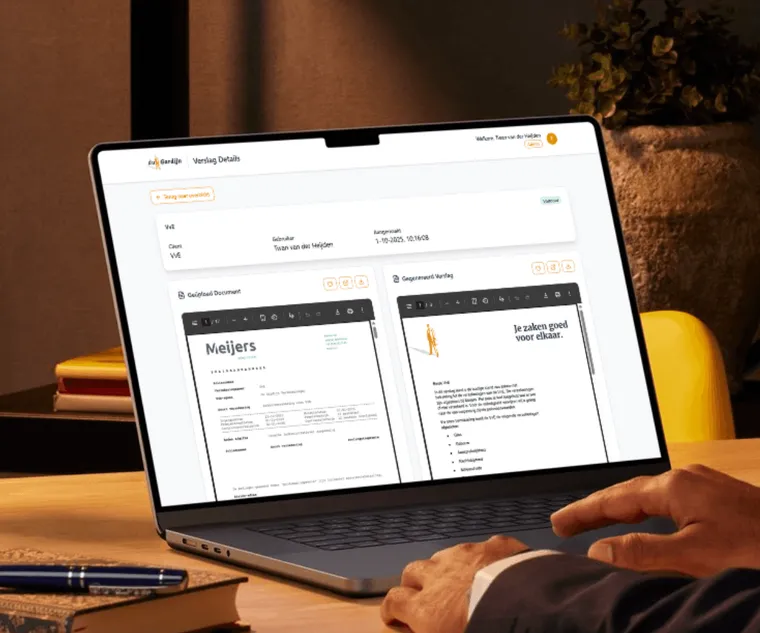
AI reads documents, pulls out what matters and sets it side by side. At du Gardijn Verzekeringen, AI compares policy schedules and fills in owners' association reports: from upload to result in 30 seconds, for around 4,400 policy analyses a year.
-
Case file and document management
Every case file complete, in one place.
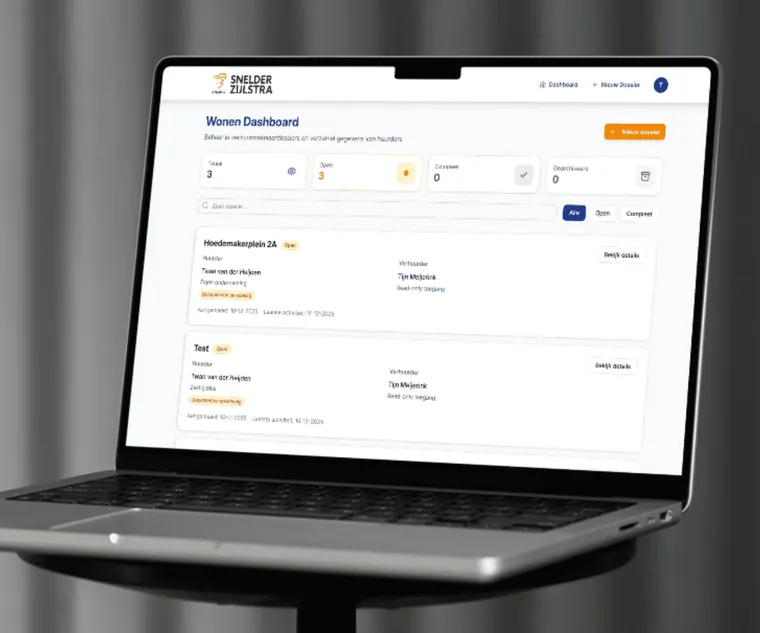
Documents and data arrive in a structured way and sit in one overview, instead of scattered across email and folders. For Snelder Zijlstra Makelaars we built a secure portal with an intake per tenant profile, a real-time case file overview and controlled access with retention periods: 30 to 60 minutes saved per case file.
-
Research and reporting
From scattered sources to one report.
Bringing knowledge together often takes days: searching, reading, summarising, writing up. For LAB63 an agent workflow prepares research, synthesis and reporting from the kick-off, with five agents researching in parallel. That saves 3 to 5 days per project.
What it costs
A knowledge base at a fixed price.
No hourly billing. Together we decide which sources and questions are in scope, you know the cost up front, and keeping the knowledge base up to date runs on a predictable monthly fee.
Core sectors, 02
The sectors where our proof runs deepest
Financial services and real estate are our sharpest vertical focus, backed by working solutions and hands-on delivery experience.
What is AI knowledge management?
Knowledge management is capturing, organising and making findable the knowledge in an organisation, so everyone works with the same, up-to-date information. That knowledge sits in documents, systems and the heads of experienced staff. AI knowledge management makes it searchable with ordinary questions: an AI model first finds the relevant passages in your own sources and then builds an answer on them, with a reference to the document.
How does AI search across documents work?
The documents are split up and indexed by meaning, not just by keywords. When you ask a question, the system retrieves the passages that deal with it and the language model turns them into an answer. That technique is called RAG (retrieval-augmented generation). Because the answer comes from your own sources, you can always check it.
What is the difference between document management and knowledge management?
Document management is about storing, organising and securing documents: folders, versions, permissions and retention periods, for example in SharePoint or a case management system. Knowledge management goes a step further: making the knowledge in those documents findable and usable. An AI knowledge base builds on your document management. It uses the files, versions and permissions that already exist, and gives an answer instead of a list of files.
Do I need separate knowledge base software?
Usually not. Traditional knowledge base software needs someone to write the knowledge up as articles and keep them current. An AI knowledge base works on the documents you already have, for example in SharePoint, Google Drive or your case management system, and picks up new versions automatically. Where knowledge has not been captured anywhere yet, we start by capturing it.
Is this the same as ChatGPT or Microsoft Copilot?
No. General-purpose assistants know a lot about the world, but little about your internal policies, procedures or client files, unless those have been properly made accessible. A knowledge base on your own sources gives answers that are right for your business, with source and version. It can sit perfectly well alongside Copilot or ChatGPT.
Which sources can go in?
Anything that holds knowledge: policies, handbooks and procedures, Word and PDF files, SharePoint and Google Drive, wikis, tickets and email, and data from your systems such as your CRM or case management. We start with the sources that most questions are about.
How do you stop the AI making things up?
By letting the model answer only on the basis of the passages it has found, and always showing the source. If the system cannot find a good source, it says so instead of guessing. In the early phase we test with real questions from your staff and refine until the answers are right.
Does the knowledge base stay up to date?
Yes, if you connect it to the place where documents are updated. New versions are picked up automatically and old versions are no longer used. At HypotheekCompany every answer shows the source excerpt, the lender and the document version, so staff can always check what the answer is based on.
What about permissions, confidentiality and GDPR?
We set up the knowledge base so it follows the permissions you already have: anyone who may not open a document gets no answer from it either. We work with business AI models that do not use your data for training, choose processing within the EU wherever possible and record that in a data processing agreement.
How do you retain the knowledge of experienced staff?
By capturing knowledge at the moment it is created: in conversations, case files and decisions. At In het Veld, conversations are automatically stored, transcribed and turned into action points, with one central source of truth for the whole team. Whatever is captured that way can then become searchable in a knowledge base.
What does AI knowledge management cost?
That depends on the number of sources, the volume of documents, the integrations with your systems and the number of users. We agree a fixed scope and a fixed price up front, and a first version on a defined set of sources is often live within a few weeks. Keeping it up to date runs on a predictable monthly fee. Book an intro call for an estimate for your situation.
How does a knowledge base relate to an AI Operating System?
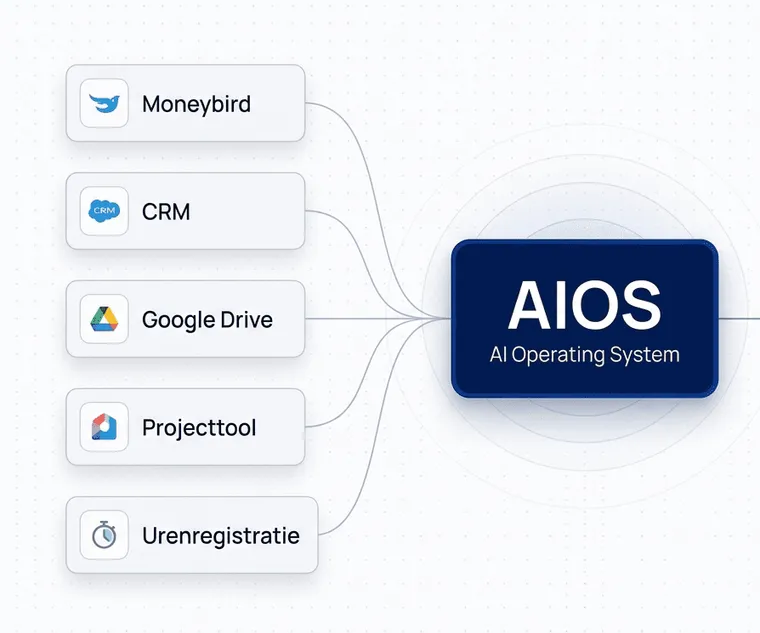
A knowledge base is often the first layer of an AI Operating System: first make the knowledge findable, then connect systems and let AI take over work. You can start with the knowledge base without building the whole system straight away, and extend it later where it adds value.
Our other services
- AI audit In 14 days, a prioritised opportunity report with ROI per opportunity.
- AI consultancy A strategic sounding board that sets the right AI direction.
- AI agents Digital workers that take tasks off your plate, live within 2–4 weeks.
- AI customer service Customer questions handled 24/7 on web, WhatsApp and email, with a human in the right place.
- AI automation Repetitive work gone: documents, invoices, customer contact and integrations, automated with AI.
- Custom AI software Web apps, automations and integrations. Fixed scope, fixed price.
- AI Operating System One system that brings all your business data together and makes it searchable.
- AI workshop In a single day, from theory to hands-on AI skills for your team.
- System integration API integrations and one integration layer, so data flows by itself.
- Finance automation Invoices, controls and month-end close, with the controller in charge.


You can feel it has to change,
we
show you how.
You know where the friction is. We help you figure out how AI can genuinely fix it.
Not ready for a conversation yet? Get honest AI advice first →
30 minutes. Online or in Enschede. You decide.