


AI governance · EU AI Act

AI governance: control over how your organisation uses AI.

AI governance is the set of agreements, roles and controls that determine how your organisation uses AI: an AI policy, AI literacy for your people, a register of AI applications and the obligations under the EU AI Act. We put it in place for mid-sized organisations, together with the AI applications themselves.

AI governance · EU AI Act

Trusted by

Definition

What is AI governance?

AI governance is the set of agreements, roles and controls through which an organisation decides how AI is used, who is responsible and how risks are managed. In practice it comes down to five elements: an AI policy, a register of AI applications, an owner for each application, AI literacy among staff and periodic review.

AI governance is broader than an AI policy.

The policy is the working agreement staff read: which tools are allowed, which data never goes in and where a person checks. Governance is the system around it: who maintains the policy, how you assess a new application and how you adjust course when something goes wrong.
The EU AI Act makes part of this mandatory.

Anyone deploying AI takes measures to support the AI literacy of their people (Article 4). Since 2 August 2026 it must also be recognisable when customers are talking to your AI or seeing realistic AI-generated images. For most applications in mid-sized organisations, that is where it ends: the heavy requirements apply to high-risk AI.

Governance only works if it fits how your team works today.

A policy that bans everything gets bypassed, and that is how shadow AI starts. So we begin with what is already running, set the agreements down in a few pages and make sure the official route is faster than the unofficial one. AI governance is one of the six building blocks of an AI operating model.

Step by step

Six steps to workable AI governance.

From overview to routine. The order matters: without a register, you do not know what you are governing.

  1. Step 1: Map which AI is running

    Build a register of all AI tools and applications, official and unofficial: who uses what, for what, with which data and who owns it. Without this overview you cannot meet the rest.

  2. Step 2: Determine your role and risk under the AI Act

    For each application: are you the provider or the deployer, and which risk category does it fall into? Most applications fall into minimal or limited risk. AI in recruitment or credit scoring comes under stricter rules from 2 December 2027.

  3. Step 3: Write a two-page AI policy

    Set out which tools are allowed, which data must never go in, which output a person checks, when you tell customers they are dealing with AI and who the owner is. Short enough to actually be read.

  4. Step 4: Organise AI literacy per role

    Article 4 calls for measures that fit who uses AI, for what, and who feels the consequences. Senior management needs different knowledge from a client adviser. Record who received which explanation or training.

  5. Step 5: Appoint owners

    Senior management is ultimately accountable, with an owner from the business for each application who decides what AI does and checks that it works. A full-time Chief AI Officer is often too heavy for a mid-sized organisation.

  6. Step 6: Review at a fixed moment

    Tools, legislation and processes change. Review the register, policy and training at a set moment, every six months for example, and adjust them to what you see in practice.

Comparison

No rules, a total ban or AI governance.

Three ways organisations deal with AI use, and what each one means for visibility, data, the AI Act and what AI delivers.

Choose which model to highlight
No rules Ban everything AI governance
Visibility of AI use Nobody knows which tools are running Use carries on, out of sight A register of all AI applications
Customer and company data Can end up in public tools without any agreements The risk remains, just unseen Fixed rules per type of data, with business accounts
AI literacy Not arranged Not arranged, because AI is officially absent Suitable explanation per role, recorded
AI Act Unclear which rules apply Obligations apply as soon as anyone uses AI Role and risk known for each application
What AI delivers Scattered time savings for individuals Disappears or goes underground Shared, measured and scaled up
Ownership Nobody IT as gatekeeper Senior management accountable, an owner per application

Our services

From frustration to solution, this is what we do.

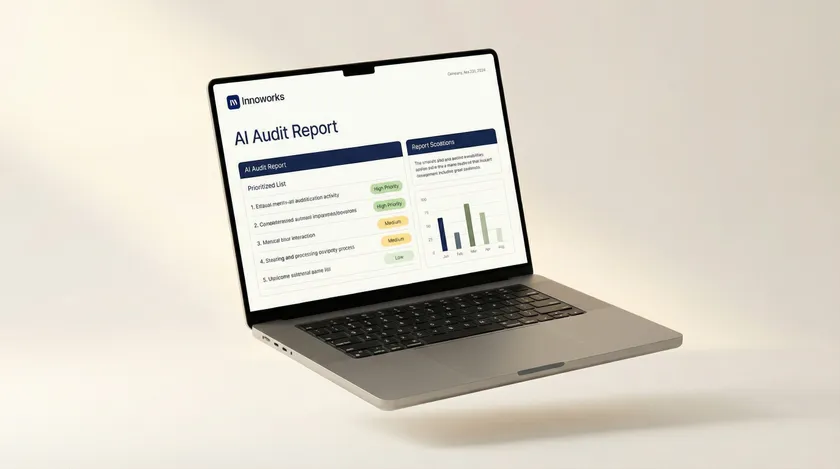
AI audit example

AI audit

Know where AI truly pays off, in two weeks.

In 14 days we map where AI delivers concrete time, money or quality in your business. No hype, no generic tips. Just a report with prioritised opportunities, a live presentation and a clear next step.

14 days From intake to report Fixed lead time
3 deliverables Report, presentation, roadmap Concrete and measurable
Quick wins Scored on impact and feasibility What first and what later
Evidence ROI per opportunity in euros No gut feeling
Learn more

View all services

Where to start

Start with the register.

In an AI audit we map in 14 days which AI tools are running in your organisation, official and unofficial, what risk comes with them and what literacy each role needs. You receive the register and the basis for your AI policy. After that we help with the policy, the training and the set-up, with a fixed scope and price for each step.

Frequently asked questions

Questions you probably have too.

Still have questions? Get in touch
What is AI governance?

AI governance is the set of agreements, roles and controls through which an organisation decides how AI is used, who is responsible and how risks are managed. In concrete terms: an AI policy, a register of AI applications, an owner for each application, AI literacy among staff and periodic review. For a mid-sized organisation that fits on a few pages and a regular meeting.

What is the difference between an AI policy and AI governance?

An AI policy is the working agreement for staff: which tools are allowed, which data never goes in and where a person checks. AI governance is the system around it: who maintains the policy, how you assess new applications, how you organise AI literacy and how you adjust course. The AI policy is therefore one part of AI governance.

What should an AI policy contain?

An AI policy for a mid-sized organisation answers seven questions: what you use AI for and who the policy applies to (including freelancers and interns), which tools are allowed, which data must never go in, which output a person checks, when you tell customers they are dealing with AI, what explanation or training each role receives, and who maintains the register and how often you review the policy. It fits on two sides of A4.

Is AI literacy mandatory?

Yes. Article 4 of the AI Act has applied since 2 February 2025 to everyone who deploys AI. Since 27 July 2026 a lighter text has applied through the Digital Omnibus on AI (Regulation (EU) 2026/1744): you take measures to support the AI literacy of your people, but you do not have to guarantee a particular level. Doing nothing at all does not comply. A certificate is not needed; an internal record of training and instructions is enough.

How do you organise AI literacy in your organisation?

Start with the register: who uses which AI tools, and for what. For each role, decide what someone needs to know: what a tool can and cannot do, when output must be checked, which data must not go into public tools, what a hallucination is and who is responsible if AI makes a mistake. Provide training that fits the role, record who received which explanation and repeat it when tools or tasks change. For the municipality of Twenterand we delivered such a training for policy officers, communications advisers and administrative staff, focused on using AI safely in their work.

What happens if you do not arrange AI literacy?

The AI Act itself sets no fine for AI literacy. In the Netherlands, under the draft implementing act, the Dutch Data Protection Authority (Autoriteit Persoonsgegevens) supervises Article 4, with the AFM and DNB for financial institutions. If you fall short, the supervisor can impose an order subject to a penalty payment (last onder dwangsom): an instruction with a deadline that only costs money if you let that deadline pass. The implementing act is still a bill; the obligation itself already applies, because the regulation has direct effect.

What does the EU AI Act mean for SMEs?

For most SMEs and mid-sized organisations the AI Act is manageable. You are usually the deployer, not the provider, and most applications fall into minimal or limited risk. What applies: supporting AI literacy, making it recognisable when customers are talking to your AI or seeing realistic AI-generated images, and avoiding the prohibited practices. The heavy requirements for high-risk AI, such as AI in recruitment or credit scoring, apply from 2 December 2027, and for AI in products from 2 August 2028.

What is an AI governance framework?

An AI governance framework is the fixed structure in which you set down AI governance: principles, roles, a register, risk assessment, controls and review. Well-known frameworks are ISO/IEC 42001, the international standard for an AI management system, and the voluntary AI Risk Management Framework from the US NIST. For a mid-sized organisation certification is rarely the goal; such a framework mainly serves as a checklist. The six steps on this page are a workable start.

Who is responsible for AI governance?

Senior management is ultimately accountable, not IT alone. For each application you appoint an owner from the business who decides what AI does and checks that it works. Larger organisations sometimes appoint a Chief AI Officer; for mid-sized organisations a full-time role is often too heavy and an external partner can partly fill it. You do not need to appoint an AI officer for Article 4.

How do you tackle shadow AI?

Not with a ban: staff do not stop, they hide their use and you lose visibility. What works: taking stock of which tools are running without punishing anyone for the answer, a short guideline on which data may and may not go into AI tools, and an official route with business tools that is faster than the unofficial one.

Does Innoworks give legal advice on the AI Act?

No. Innoworks is an AI implementation partner, not a law firm. We map which AI is running, set up the policy, the training and the processes, and build the applications. For a legal review, for example of a high-risk application or a contract, you work with a lawyer; we make sure practice matches what they advise.

What does setting up AI governance cost?

That depends on the size of your organisation and what is already in place. We work in steps with a fixed scope and price for each step, usually starting with an AI audit. Book an intro call for an estimate for your organisation.

You can feel it has to change,
we show you how.

You know where the friction is. We help you figure out how AI can genuinely fix it.

Not ready for a conversation yet? Get honest AI advice first →

30 minutes. Online or in Enschede. You decide.